
A religious Jew who actually cares to read the (first) book of Maccabees will discover quite a few surprises that he or she probably did not learn in school about the story of Hanukkah. One of the most surprising, perhaps, because it is so at odds with the implication of the canonical liturgical text (a fancy way of saying “prayer”) known as “Al ha-Nissim,” is that the Maccabees did not actually win the war, establish a Jewish kingdom, and rededicate the holy temple. It’s true that they did those things, but not in that order. The book of Maccabees describes the establishment of Chanukah in 165 BC when the Temple was recaptured and reconsecrated (1 Maccabees 4:59) but this actually occurred in the middle of the war. The fighting (both military and political) continued for decades, detailed in the successive chapters of Maccabees I.
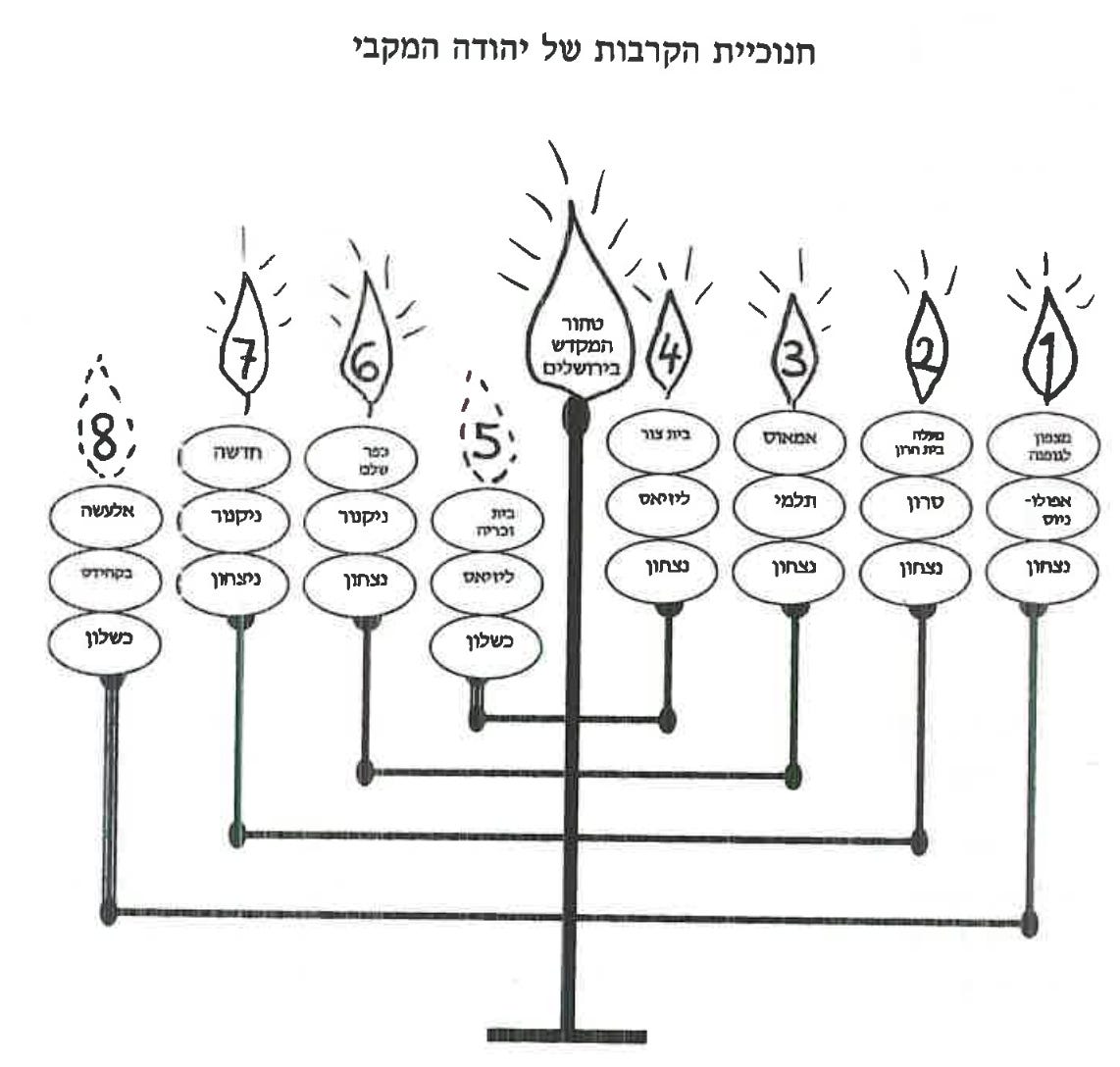
There is a sense in which the institution of Chanukah actually comes at the center of Yehudah Maccabee’s eight battles; you have to fudge it a little bit but there’s a lovely article demonstrating the “centrality” (chronologically speaking) of Chanukah within those battles by Ze'ev Erlich, an archaeologist and famed tour guide who tragically lost his life just a few weeks ago helping with today’s Jewish battles in southern Lebanon. His whole article can be found here, but the punchline is this diagram on the last page, named with the locations, enemy generals and outcome (numbers 5 and 8 are placed lower because those battles were unsuccessful):
Historical studies and chassidishe Torah don’t always mix well, so in this case I’ll try to do so without violating the proverbial prohibition of “kila’im”. But in chassidus especially, which often seeks to find connections between the weekly Torah reading and the time of year, one of the classic ‘hints’ to the word Chanukah in the Torah is in the verse in Parashas Mikeitz describing how Yosef, hiding behind the identity of Egyption viceroy, prepared a feast for his brothers who came this time with Binyamin:
וירא יוסף אתם את בנימין ויאמר לאשר על ביתו הבא את האנשים הביתה וטבח טבח והכן כי אתי יאכלו האנשים בצהרים
Yosef saw Binyamin with them and he said to the one who was in charge of his house, "Bring these men to the house and slaughter an animal [lit: slaughter the slaughter] and prepare it, because the men will eat with me at noon."
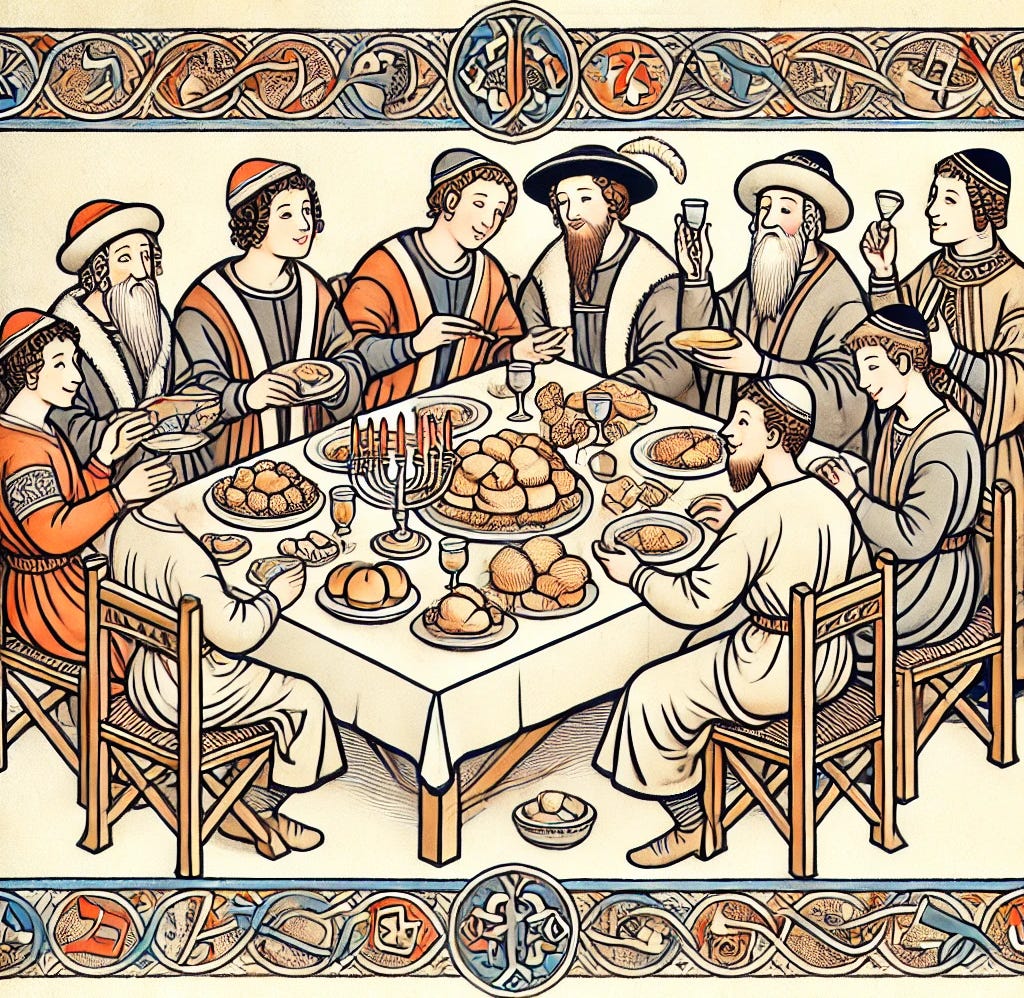
If you rearrange the last five words of the phrase ‘וטבח טבח והכן’, you’ll get the letters חנוכה, Chanukah. Of course, you need to be a Chassidishe rebbe to see the Chanukah connection, but anyone reading the Torah can appreciate the psychological moment captured here. Yosef was not celebrating the end of the story, some final redemption or even resolution of the tension between himself and his brothers. His brothers, not knowing the true identity of this mad king who imprisoned Shim’on, returned their gold, and is now throwing them a party, were likely filled with anxiety and apprehension. And yet, they ate and drank. They recognized that God was granting them some small win and took the opportunity to celebrate it (see Rashi 43:34, that until that day, neither Yosef or his brothers drank wine in all the years that they had been separated).
Yosef’s brothers, even amidst all their anxiety about Shimon's imprisonment and the mysterious return of their money, participated in this moment of joy, toasting to their unification (they didn’t even know just how unified they were, that their long lost brother was also in attendance). And here we find an extraordinary similarity to the establishment of the Chanukah holiday. We can imagine Yaakov’s sons as celebrating while in the thicket between feelings of gratitude and dread - much like the Maccabees who chose to celebrate while still in the thick of battle.
The “vort” connecting Chanukah to this feast is primarily based upon the word והכן - “and prepare.” The meal to which Yosef invited his brothers was a ‘taste of the world to come,’ so to speak, a preparation for something much greater that they were not yet ready for. This meal they ate while still kept in the dark regarding the true identity of this duplicitous despot. But Yosef knew, and he was preparing them for what it would feel like when they’d finally be “in” on the secret.
On Chanukah, we are not celebrating our arrival at the ultimate destination. There is still a long road ahead, we are still in the dark as to the true meaning behind all this mad suffering. But we are preparing, and we know to thank God for the small lights that He provides along the way, pointing us towards home.
מי שעשה נסים לאבותנו הוא יעשה לנו נסים ויגאל אותנו בקרוב